Scientific Project Management

How can a scientific ideabe transformed into a successful project with tangible results? From establishing the rationale for an idea and securing funding to building a team, managing resources, and evaluating outcomes, the course introduces the key principles of scientific project management.
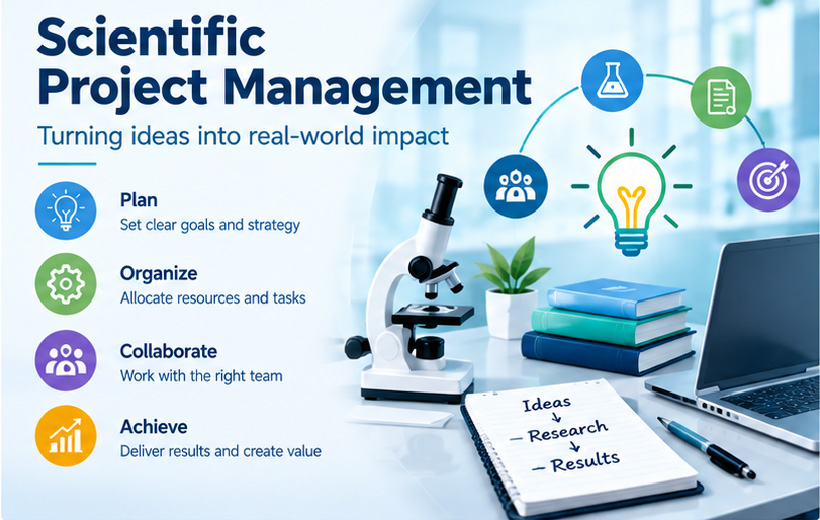
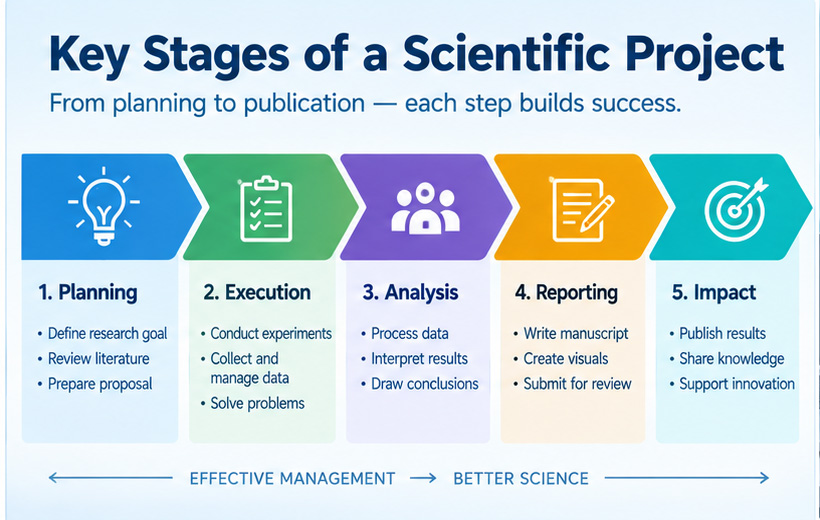
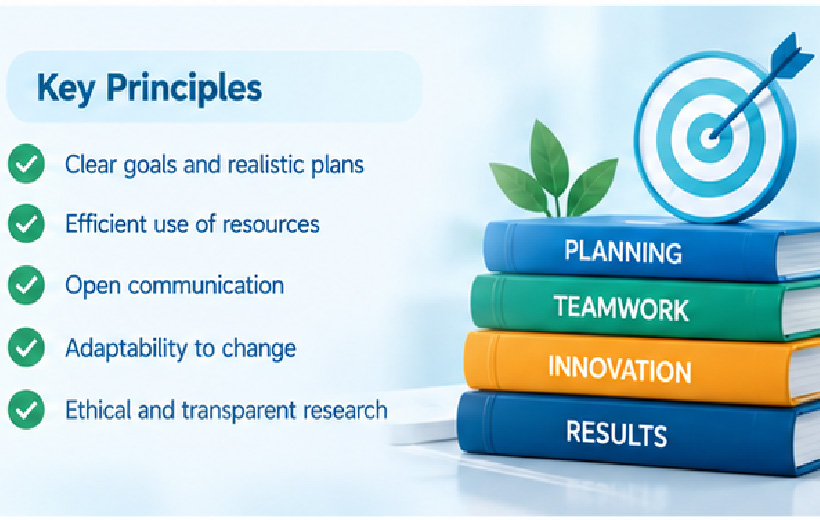
This course focuses on contemporary approaches to scientific project management, including the justification of project relevance and feasibility, the planning of implementation stages, budget development, funding acquisition, and the evaluation of project effectiveness. Particular emphasis is placed on the preparation of grant applications and project documentation, engagement with international research funding programmes, team management, and project implementation monitoring and control. Upon completion of the course, students will be able to develop and justify scientific project proposals, plan resources and assess risks, prepare grant applications and project reports, and evaluate project outcomes and the potential impact of research activities.
The purpose to develop Master’s students’ knowledge and skills in designing, evaluating and implementing scientific projects.


The course is delivered in the form of :
- lectures – 20 hours*
- seminar classes – 10 hours*
- independent student study – 60 hours*
Control and Assessment Methods
Current assessment includes oral questioning and defence of the individual research-oriented assignment during lectures and seminars. Periodic assessment is module testing after each content module. Final assessment is an examination. The level of a student’s knowledge is evaluated on a 100-point scale.
Detailed information on assessment methods and criteria is provided in the course working program
For all organisational inquiries, please contact ONU-DUANKOM coordinator, Tetiana Ivanytsia.
t.ivanytsia@gmail.com
 Level 2: Master’s
 105 hours study:
Credits – 3,5
Content Modules – 2
-
Field of Knowledge: G Chemical and Bioengineering
-
Specialty: G21 Biotechnology and Bioengineering
-
Educational and Professional Program “Biotechnologies and Bioengineering”
Successful completion of this course will be enhanced if students already have experience in conducting research and preparing a Bachelor’s thesis or equivalent academic work.
Knowledge of scientific-research organisation and intellectual-property fundamentals may be useful for the courses “Biological Sciences and Sociology” and “Management in Educational Institutions”, as well as for research internships and preparation of the Master’s thesis.


