Stem Cells and Their Applications
One Cell. Endless Possibilities.
What makes a stem cell unique, and can its ability to differentiate be harnessed to repair damaged tissues? The course explores the characteristics of stem cells, the mechanisms underlying their self-renewal and differentiation, the differences between embryonic and adult stem cells, and the potential applications of stem cells in modern medicine and biomedical research.
Key terms: stem cells, еmbryonic stem cells, differentiation, self-renewal, biomedicine
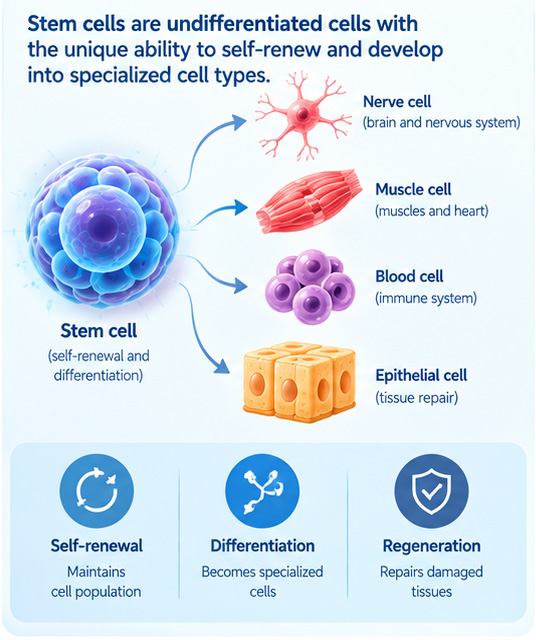

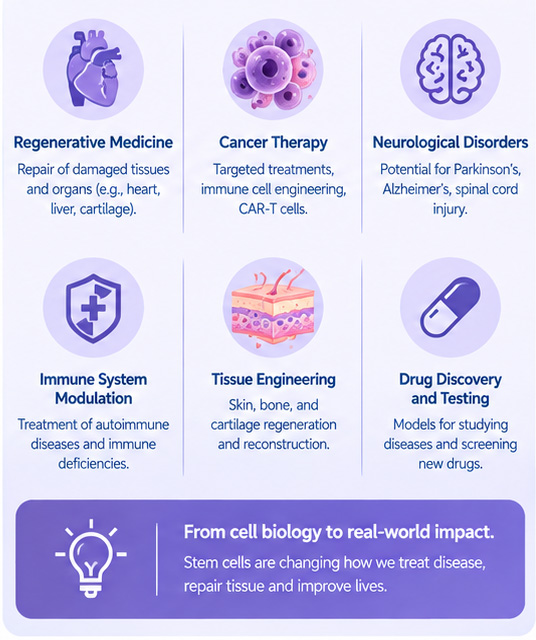
The course focuses on current concepts of stem cell biology, properties, classification, and differentiation, methods of stem cell isolation and storage, and the main areas of their application in medicine and scientific research. Particular attention is given to the characteristics of embryonic and adult stem cells, the prospects for their use in regenerative medicine, and the ethical considerations surrounding the use of embryonic stem cells. Students develop skills in searching for, analyzing, and systematizing current scientific information on stem cells, evaluating their application prospects, and applying the knowledge acquired to address research and practical challenges.
Purpose of the course “Stem Cells and Their Applications” is to familiarize applicants with the theoretical foundations of life, differentiation, methods of obtaining and classification of stem cells and to provide a system of knowledge on the main areas of use of stem cells in medicine to future specialists - applicants for higher education in specialty G21 Biotechnology and Bioengineering.


Forms and Methods of Instruction
The course is delivered in the form of :
- lectures – 22 hours*,
- practical classes – 8 hours*,
- organized independent student work – 60 hours*
* may vary for Ukrainian and English language classes
The main training of students is carried out during lectures; however, a significant part is also based on independent study of the subject.
During lectures, verbal and visual teaching methods are used. Lectures and seminar classes are held in the form of conversations, discussions of reports, and debates, which contributes to the development of creative independence of applicants, deepens their interest in science and scientific research, cultivates pedagogical tact, develops language culture, public speaking skills, and participation in discussions. Applicants get acquainted with articles in special publications, solve problem situations.
Control and Assessment Methods
Modular control for each content module is carried out using a survey.
The final assessment is the result of the total control (weighted average of the grades for each content module).
The applicant's level of knowledge is assessed on a 100-point scale. Detailed information on assessment methods and criteria is provided in the course working program.
For all organisational inquiries, please contact ONU-DUANKOM coordinator, Tetiana Ivanytsia.
t.ivanytsia@gmail.com
 Level 2: Master’s
 90 hours study:
Credits – 3
Content Modules – 2
-
Field of Knowledge: G Chemical and Bioengineering
-
Specialty: G21 Biotechnology and Bioengineering
-
Educational and Professional Program «Biotechnologies and Bioengineering»
- «General Cytology»,
- «Cell Biology»,
- «Genetics»,
- «Molecular Biology»,
- «Biochemistry»,
- «Human Physiology»,


